


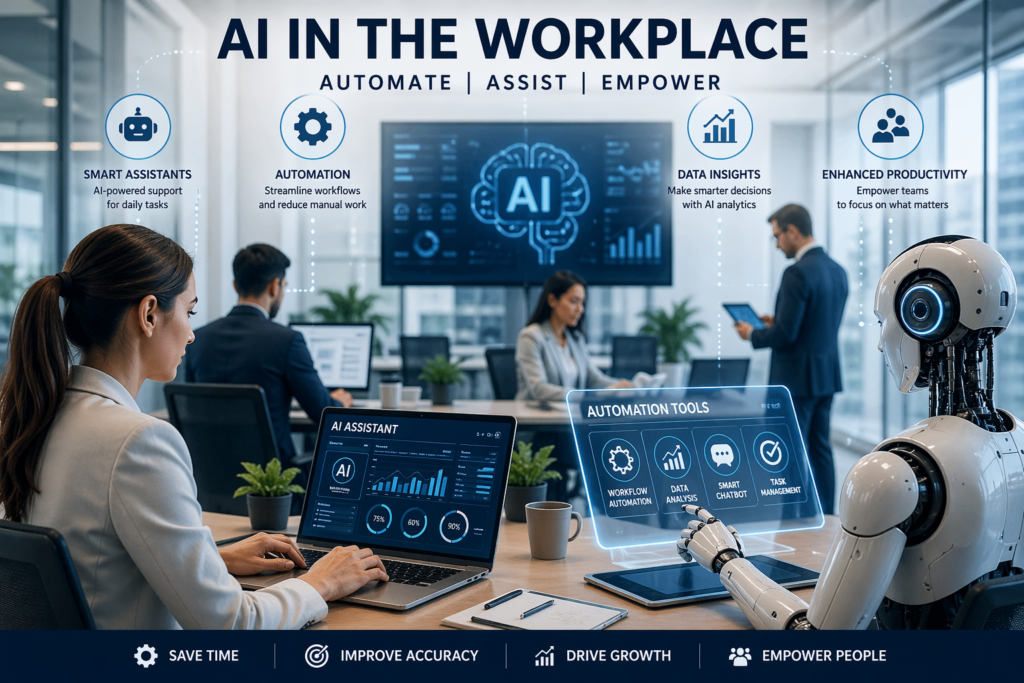
How AI Is Reshaping Everyday Jobs in 2026
Introduction
Artificial Intelligence (AI) is no longer a futuristic concept, it is now deeply embedded in our daily work lives. In 2026, AI is transforming how people perform routine tasks, make decisions, and interact with technology across industries. From automating repetitive processes to enhancing creativity and productivity, AI is reshaping everyday jobs at an unprecedented pace.
This article explores how AI is influencing modern workplaces, the opportunities it creates, and the challenges professionals must navigate to stay relevant in an AI-driven world.
The Rise of AI in the Workplace
AI adoption has accelerated rapidly over the past few years. Businesses of all sizes are integrating AI tools to improve efficiency, reduce costs, and enhance decision-making. Unlike earlier automation technologies, AI systems can learn, adapt, and perform complex tasks that previously required human intelligence.
In 2026, AI is not just limited to tech companies. It is widely used in industries such as healthcare, education, retail, finance, and customer service. This widespread adoption has significantly changed the nature of everyday jobs.
Automation of Repetitive Tasks
One of the most visible impacts of AI is the automation of repetitive and time-consuming tasks. Jobs that involve data entry, scheduling, customer inquiries, and basic analysis are increasingly handled by AI-powered systems.
Examples:
- Customer service chatbots handling common queries
- AI tools managing email responses and scheduling meetings
- Automated data processing in finance and accounting
This shift allows employees to focus on more meaningful and strategic work rather than routine operations.
Enhanced Productivity and Efficiency
AI tools are significantly boosting workplace productivity. Employees can now complete tasks faster and with greater accuracy using AI-powered assistants.
Key Benefits:
- Faster data analysis and insights
- Improved workflow automation
- Reduced human error
For example, marketing professionals use AI to analyze consumer behavior, while project managers rely on AI tools to optimize timelines and resource allocation.
Transformation of Job Roles
AI is not just replacing tasks, it is transforming entire job roles. Many professions are evolving to include AI collaboration as a core component.
How roles are changing:
- Writers use AI for research and drafting content
- Designers leverage AI for faster prototyping
- Doctors use AI for diagnostics and treatment recommendations
- Teachers use AI to personalize learning experiences
Instead of replacing humans entirely, AI is augmenting human capabilities.
Creation of New Job Opportunities
While AI automates certain tasks, it is also creating new job opportunities. The demand for AI-related skills has increased significantly.
Emerging roles:
- AI specialists and engineers
- Data analysts and scientists
- AI ethics consultants
- Automation strategists
Additionally, many traditional roles now require basic AI literacy, making digital skills more important than ever.
AI in Remote and Hybrid Work
The rise of remote and hybrid work models has been supported by AI technologies. AI-powered tools help teams collaborate effectively regardless of location.
Examples:
- Smart meeting assistants that summarize discussions
- AI-driven productivity tracking tools
- Virtual collaboration platforms with automation features
These tools ensure seamless communication and maintain productivity in distributed teams.
Challenges and Concerns
Despite its benefits, AI also presents challenges that cannot be ignored.
1. Job Displacement
Some roles, particularly those involving repetitive tasks, are at risk of being replaced by AI. Workers in these roles must adapt by learning new skills.
2. Skill Gaps
There is a growing gap between the skills employees have and the skills required in an AI-driven workplace. Continuous learning is essential.
3. Ethical Concerns
AI raises concerns about data privacy, bias, and decision-making transparency. Organizations must ensure responsible AI usage.
The Importance of Upskilling
To stay competitive in 2026, professionals must embrace lifelong learning. Upskilling and reskilling are no longer optional—they are necessary.
In-demand skills:
- AI and data literacy
- Critical thinking and problem-solving
- Creativity and innovation
- Emotional intelligence
Human skills such as communication and adaptability remain irreplaceable, even in an AI-driven world.
Human + AI Collaboration: The Future of Work
The future of work is not about humans versus AI. it is about collaboration. AI excels at processing data and performing repetitive tasks, while humans bring creativity, empathy, and strategic thinking.
Ideal workflow:
- AI handles data and automation
- Humans focus on decision-making and innovation
This partnership leads to better outcomes and more efficient workflows.
Industry-Specific Impacts
Healthcare
AI assists in diagnostics, patient monitoring, and treatment planning, improving accuracy and efficiency.
Education
AI enables personalized learning experiences and automates administrative tasks for educators.
Retail
AI enhances customer experience through personalized recommendations and inventory management.
Finance
AI improves fraud detection, risk assessment, and financial forecasting.
Conclusion
In 2026, AI is reshaping everyday jobs in ways that were unimaginable just a decade ago. While it brings challenges such as job displacement and skill gaps, it also offers immense opportunities for growth and innovation.
The key to success in this new era lies in adaptability. By embracing AI, developing new skills, and focusing on uniquely human abilities, professionals can thrive in an AI-driven workplace.
The future is not about replacing humans, it is about empowering them.
Read More About GrokAi